yllix banner

Supercharge Student Self-Editing Skills with this Writing Checker for Google Docs

Analyzing your own writing with a critical eye can be hard to do. I know, I try to do it every day and I still miss things that a fresh set of eyes quickly picks up. Like me, students often struggle to critically analyze their own writing. Peer editing is one solution to that problem. Another solution is to use an online writing checker the one that JoeZoo offers as a Google Docs Add-on. JoeZoo's Monkey Checker is a customizable tool that students can use to evaluate their own written work.

Five Key Features of JoeZoo's Monkey Checker
  • JoeZoo's Monkey Checker is a part of the JoeZoo Google Docs Add-on that you can get right here. Once it is installed you can begin customizing how it works for you and your students.

  • You can pick the spelling, grammar, and punctuation rules that you want the Monkey Checker to identify. Many services will identify all errors, but if you want students to be responsible for self-identifying small errors and let Monkey Checker identify the bigger errors, you can have it do that.

  • Many grammar, spelling, and punctuation checkers will automatically fix errors for students. Monkey Checker only suggests corrections. I like that because it forces students to look at their mistakes and make corresponding corrections.

  • Errors are color coded within Google Docs. Errors of the same type are color coded and grouped for easy identification by students and teachers. This makes it easy to quickly identify the type of mistake that a particular student makes most often.

  • An originality checker is built into JoeZoo's Monkey Checker. Sometimes students don't intend to do it, but they end up including too much of another person's work in their own papers. The originality checker lets teachers instantly check if a student copied any part of their work from other students in the class  
Want to see these features in action? Watch this short video to see how you and your students can benefit from using JoeZoo's Monkey Checker for Google Docs.


Disclosure: JoeZoo is an advertiser on this blog. That said, I was writing about JoeZoo and including it in workshops long before they started advertising. 

from Free Technology for Teachers https://ift.tt/2Rpv1N1

5 Good Places to Find Public Domain Video Clips

There are plenty of places to find public domain images online. But finding public domain video clips isn't quite as easy as finding public domain images. Part of the reason for that is the cost associated with hosting videos. Should you find yourself or your students in need of public domain video clips to mix into video projects, try one of these five places that host public domain videos that you can download.

Last month the Library of Congress launched the National Screening Room. The National Screening Room currently offers about 300 videos. The videos are digital copies of films made in the 19th and 20th centuries. You can browse the collection by date, location of the filming, and subject. You can also search for videos that are parts of other LOC collections. All of the videos in the National Screening Room can be viewed online and or downloaded as MP4 files.

Flickr is known for hosting millions of images, but it also hosts lots of videos. The advanced search tools within Flickr make it easy to find videos that have Creative Commons licenses or have a public domain designation. With just one click those videos can be downloaded to your computer. Watch my video embedded below to learn how to find public domain videos on Flickr.


Pixabay has been one of my go-to sites for public domain images for years. Pixabay also offers public domain video clips that you can download for free. To find video clips on Pixabay simply choose "video" from the drop-down menu that appears in the right edge of Pixabay's search box.

Stockio, like Pixabay, offers a mix of public domain pictures and videos to download for free. To download a video from Stockio simply click the "download" button that appears to the right of all videos. Registration is not required in order to download videos from Stockio.

The Public Domain Review is a website that features collections of images, books, essays, audio recordings, and films that are in the public domain. Choose any of the collections to search for materials according to date, style, genre, and rights. Directions for downloading and saving media is included along with each collection of media.

Learn more about mixing public domain videos into your own video projects in my upcoming course, Video Projects for Every Classroom

from Free Technology for Teachers https://ift.tt/2JuWFoQ

Captions, Dice, and Ninjas - The Month in Review

Good morning from Maine where we're ready for some Halloween fun. Last year we had more than 600 trick o' treaters come to our house! And if the weather is nice we'll have that many again this year. But Halloween isn't the only thing happening today. It's the end of the month and as I do every month I have put together a list of the most-read posts of the last month. Take a look and see if your favorite made the list.

October was a busy month here are the Byrne Instructional Media world headquarters. I started the month by working with teachers of Sigsbee Charter School in Key West then I was off to West Virginia for a conference followed by a conference in Connecticut. In there I taught two professional development courses too. If you're interested in having me come to your school or conference, please get in touch.

These were the most popular posts in October:
1. 250 Google Tools Tutorials for Teachers
2. How to Create Storyboard Templates in Google Slides or PowerPoint
3. Virtual Dice and Random Number Generators
4. Using Brush Ninja and Screencastify to Make Science Presentations
5. TED-Ed Explains Why Students Should Read Classics
6. How to Use Automatic Captioning in Google Slides
7. Seven Good Places to Find Writing Prompts
8. Two Detailed Presentations About Copyright for Educators
9. Virtual Reality Book Tours
10. Case Maker - Civics Lessons Built on Primary Sources

Online PD in November
In November I'm hosting three online professional development opportunities. Those are Video Projects for Every Classroom, Google Forms & Sheets for Beginners, and Teaching History With Technology. Click here to learn more about all three opportunities.

Book Me for Your Conference
I’ve given keynotes at conferences from Australia to Alaska for groups of all sizes from 50 to 2,000+. My keynotes focus on providing teachers and school administrators with practical ways to use technology to create better learning experiences for all students. I like to shine the light on others and so I often share examples of great work done by others as well as my own. Send an email to richardbyrne (at) freetech4teachers.com book me today.

Please visit the official advertisers that help keep this blog going.
Practical Ed Tech is the brand through which I offer PD webinars.
TypingClub offers more than 600 typing lessons for kids. 
Storyboard That is my go-to tool for creating storyboards.
Book Creator is a great tool for creating multimedia books.
Kami is a great tool for annotating and collaborating on PDFs. 
University of Maryland Baltimore County offers a great program on instructional design.
Seterra offers a huge selection of geography games for students. 


from Free Technology for Teachers https://ift.tt/2Ro1Fi3

Zuckerberg says the future is sharing via 100B messages & 1B Stories/day

The News Feed won’t sustain Facebook forever, and that’s scaring investors. Today on Facebook’s earnings call, Mark Zuckerberg stressed that sharing is shifting to private chat, where people send 100 billion messages per day on Facebook’s family of apps, and Stories, where he says people share 1 billion of these slideshows per day (though it’s unclear if that includes third-party apps like Snapchat).

But that means Facebook will have to realign its business towards these mediums where monetization is more complex and it has less experience. The result of Zuckerberg’s comments was a reversal of Facebook’s initial 2 percent share price gain after earnings were announced that dragged it down to a 3.5 percent loss. That was only reversed when Zuckerberg said Facebook would reduce limits on video advertising, pushing shares up 3 percent in after-hours trading.

Facebook’s year-over-year revenue growth has already slowed from 59 percent in Q3 2016, to 49 percent a year ago, to 33 percent now as Zuckerberg admits it’s hitting saturation in developed markets, plus it’s running out of News Feed space. Now it will both have to deal with the sharing medium shift, and that the new users it’s adding in the Asia-Pacific and Rest Of World regions earn it 10X less than users in North America.

Battling iMessage

In messaging, Zuckerberg says “People share more photos, videos, and links on WhatsApp and Messenger than they do on social networks.” He sees Facebook’s position as strong, saying “We’re leading in most countries”, though that’s mostly in the developing world Android market where people choose their own default messaging app. “Our biggest competitor by far is iMessage. In important countries like the US where the iPhone is strong, Apple bundles iMesssage as the default texting app, and it’s still ahead” Zuckerberg notes.

The “bundled” language harkens back to to antitrust lawsuits against Microsoft for bundling computers with Internet Explorer. With Apple CEO Tim Cook constantly harping on the poor privacy practices of ad-supported companies like Facebook, Zuckerberg might be gunning to draw regulator attention to iMessage.
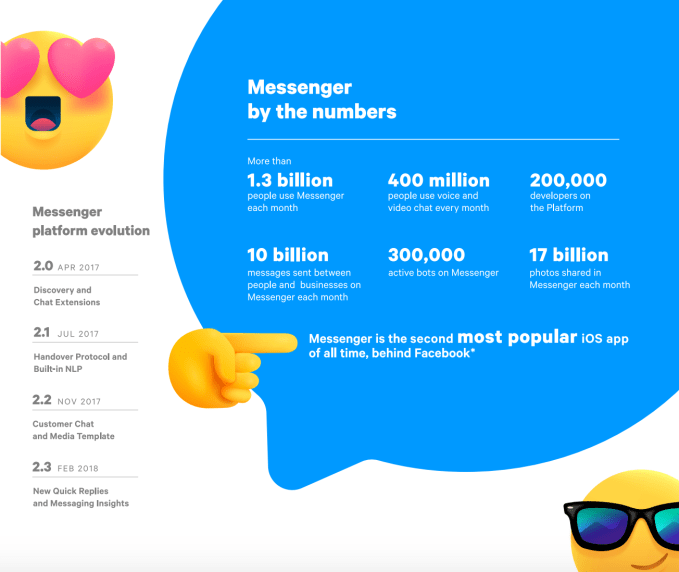
Facebook is starting to more aggressively monetize Messenger through inbox ads, and its now selling enterprise tools to brands on both Facebook and WhatsApp that let them pay to ping users. But Facebook risks its chat apps seeming annoying or intrusive if it packs in too many ads or allows too much Message spam. Users could stray to status quos like iMessage and Android Messages if it puts monetization above the user experience.

Dominating Snapchat

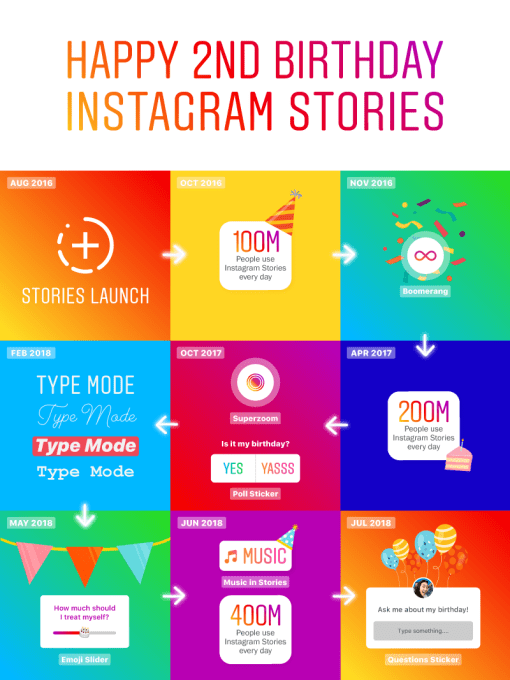
On Stories, Zuckerberg says Facebook is doing even better. Over 1 billion people use its Stories features across Facebook, Messenger, Instagram, and WhatsApp each day, compared to 186 million daily users on Stories inventor Snapchat as a whole. Stories are where the majority of Facebook sharing growth is happening, and Facebook Stories are gaining momentum after a slow and buggy start. That’s why Zuckerberg never mentioned Snapchat, and instead talk about YouTube as its primary competitor in video.

The problem is that creating attractive video ads, especially vertical full-screen ones for Stories, is beyond the capability of the long-tail on small businesses that have fueled Facebook’s News Feed ad revenue. Users often rapidly skip through Stories ads, and Facebook currently doesn’t offer unskippable ones like Snapchat. Many people don’t think to tap or swipe up to visit a link from a Story, or simply don’t want to lose their place in ways that didn’t happen on desktop or even mobile feed ads.
Chasing YouTube

Beyond Stories, Facebook salvaged its after-hours share price by discussing how it plans to show more video, and therefore more of its lucrative video ads. Back in January, Facebook admitted its Q4 user count had declined and revenue might stumble in part because it had decided to show people fewer viral videos that they watch passively. This came as part of its drive for Time Well Spent. But now, Zuckerberg says that Facebook has cracked the code for how to make passive video consumption a positive experience, so Facebook will lift some limits:

People really want to watch a lot of video. To a large degree we’ve had to rate limit its growth, and we need to do the things so we can stop limiting it. The things that have caused us to limit it are on the one hand, when we see passive consumption of video displacing social interactions . . . We needed to figure out a way that video can grow but people can also keep on interacting and doing what they tell us that they uniquely want from Facebook. And now I think we’re starting to work through what the formula is going to be so we can take some of those rate limits off and let video grow at the rate that it wants to. I feel that that’s a very exciting opportunity ahead.”

Across Facebook’s other products, Zuckerberg noted that 800 million people now use Marketplace, its Jobs feature have helped people find 1 million jobs, and its birthday fundraisers have raised $300 million alone this year. But it will be teaching advertisers how to effectively create sponsored messages and Stories ads that will define whether Facebook’s revenue keeps growing.


from TechCrunch https://ift.tt/2AzU8H9

NASA’s prolific planet-hunter Kepler has finally earned its retirement

After nine years of service, half a million stars surveyed, and thousands of planets discovered around those stars, NASA’s astonishingly successful Kepler space telescope is finally taking a well-earned rest. Out of fuel but in a safe orbit, the spacecraft will drift through the solar system looking at nothing in particular as its immense trove of data continues to drive discoveries here on Earth.

Kepler launched in 2009 after, as is so often the case, decades of preparation, studies, and delays. Its mission, slated to last three and a half years, was to stare unblinkingly at one small patch of sky, watching each star for the minute changes that could indicate a planet briefly blocking its light.

The mission was successful beyond all expectations, and once the telescope was operational the data began producing exoplanets not by the dozen but by the thousand. And some came closer to an Earth analogue than astronomers had dared hope — suggesting rocky planets about our size aren’t all that rare. (Good news if we need to relocate.)

Kepler’s “first light” image showing its original field of view.

In 2014 the original mission was complete but Kepler was still going strong, largely due to robust construction and frugal fuel use. A second mission, dubbed K2, was approved, different from the first: instead of looking at a single patch for years, Kepler would shift its view to a new location every three months. Naturally the number of stars catalogued and observed skyrocketed.

Not all was well aboard, though: The craft lost one of its four reaction wheels, used to reorientate the craft against the pull of the sun and other forces, though fortunately it was designed to function without all of them. It was only the later failure of another wheel that essentially put a hard time limit on K2.

Without a reaction wheel to change its direction along all three axes, Kepler would have to burn precious fuel every time it needed to change its view or spin around to send data home.

Fuel or no fuel, Kepler was still churning out the data. Scientists verified and announced the existence of more than 1,200 more exoplanets in one go, while AI tools like Google’s were working to find others hidden in the noisy data.

But the end has come at last, and Kepler used the last of its reserves to maneuver into position to relay its final batch of data through the Deep Space Network. This, like the rest, will soon be available to citizen scientists and research organizations as well as NASA’s own teams.

As for the exoplanet hunt, that’s been taken up by the Transiting Exoplanet Survey Satellite, or TESS, launched earlier this year and now in operation. There’s every reason to think it’ll be as productive and inspiring as its predecessor and perhaps more so.

“When we started conceiving this mission 35 years ago we didn’t know of a single planet outside our solar system,” said Kepler’s founding principal investigator, William Borucki, since retired. “Now that we know planets are everywhere, Kepler has set us on a new course that’s full of promise for future generations to explore our galaxy.”

Having delivered its last package, Kepler has completed its final duty and now enters a rather pleasant retirement. Unlike Cassini, which ended up a new crater on Saturn’s surface (a sudden but glorious end), Kepler will simply fall into an Earth-like orbit some distance behind its home planet, likely to remain stable (barring the extraordinarily unlikely possibility of a cosmic debris strike) for many years to come.

We won’t hear from Kepler, and Kepler won’t hear from us. But it’s nice to think it’ll still be looking.


from TechCrunch https://ift.tt/2Q7AcRp

Sensor Tower: Mobile game publishers continue to reach $1M at high rates

Sensor Tower reports that many mobile game publishers are hitting the $1M earnings milestone in 2021 -- though not as many as in 2016. Rea...