
Which Animals Form The Largest Colonies? |
|
Think you know the answer? |
|

from How-To Geek https://ift.tt/2BqveJE

Which Animals Form The Largest Colonies? |
|
Think you know the answer? |
|
After Exposure To Factory Waste, French Bees Were Found Producing What? |
|
Think you know the answer? |
|

Google announced gadgets and gizmos aplenty today at its annual Made by Google event, and as cool as the Pixel 4 is, the Pixelbook Go might be my favorite gadget that we saw today. It’s a seriously impressive piece of hardware.
At first blush, it may look like just another Chromebook, but that’s not it at all. It honestly seems like the return to Google’s original concept from Chromebook, though with a more modern twist. Everything the company has learned from its past Chromebooks (and Chrome OS in general) are fully realized in the Pixelbook Go.
While it may be easy to think of the Go as a sequel to the original Pixelbook, it’s really more of a lateral movement. Since it’s not a convertible (it doesn’t flip around into tablet mode), it just is what it is—a laptop for the user who wants a laptop. It still has a touchscreen, though, which is really a must on any modern laptop, but especially one that also runs Android apps.
Speaking of the display, Google has opted for a more traditional16:9 panel for the Go’s 13.3-inch display, a departure from the 3:2 format found on the Pixelbook and Pixel Slate. That’s likely to be a hit-and-miss choice from some people, but I personally think it makes a lot of sense for something that’s supposed to be a laptop and not a tablet. That said, most of the models are running at 1920×1080, which is a bit low compared to most modern machines. In my hands-on time with the Go, however, I couldn’t tell the difference compared to the Pixelbook. If you want to make sure you get the most Pixels you possibly can, however, there will be a version with a 4K Molecular Display available.
Moving below the screen is a user favorite from the Pixelbook: the keyboard. The Go’s keyboard is largely the same as the Pixelbook, except now it’s even quieter. The trackpad is also very similar, but it’s a bit larger and features rounded edges instead of the square profile found on the Pixelbook. The Go is very much about refinements.

Before we get to the Go’s innards, though, I want to quickly talk about the bottom of the device: it’s kinda weird. It’s a textured/ridged bottom that definitely makes it easier to hold and carry, which is the whole point. Google told us that the number one way most laptops get broken is by being dropped, so this is there to help prevent that. And really, if you don’t like how it looks, you’ll never see it when you’re using the laptop anyway.
On the inside, the Pixelbook Go is still quite interesting, because a lot of its components mirror what’s found in Google’s Chrome OS tablet (the Pixel Ste). All models have 8th generation Intel Core processors, along with at least 8 GB of RAM (even in the base model) and a minimum of 64 GB of storage. The sweet spot seems to be the Core i5 model with 16 GB of RAM and 128 GB of storage, but I can also see how that would be overkill for a lot of users.
If you’re looking for the meat and potatoes for the Pixelbook Go, here it is: this is a killer Chromebook. I’ve been using the Pixelbook as my main laptop for over a year and I’ve had no reason to want to change to anything else…until now. The Go is sleeker, lighter, faster, and, dare I say it, sexier. I can’t wait to get one.


Google unveiled the Pixel 4 (among other things) today at a press event, and it’s the best, most powerful, forward-thinking Pixel to date. I was able to spend some time with the phone after the event, and man, it’s so good.
The Pixel 3 XL was a pretty polarizing device, mostly because of the huge and completely unnecessary notch. The good news here is that the notch is gone on the Pixel 4 and Google is making use of the bezel along the top of the device by absolutely packing it with new tech. Like, new tech—not just “new to Pixel” tech.
I’m talking, of course, about Project Soli and the Pixel 4’s new radar chip. This new chip detects motion near the phone, allowing you to do things like skip tracks or dismiss alarms by simply waving your hand over the phone. But that’s not even the real value in the radar chip—the best part is that it’s part of the Pixel 4’s Face Unlock feature that lets you unlock your phone just by looking at it.
This isn’t Google’s first attempt at letting users unlock their phones with their faces, of course—-Face Unlock has been around for a long time. But here’s the thing: it used to be, well, bad. Like, unusably bad. It could be fooled by a picture and it really wasn’t secure at all. It was a gimmick.
But Face Unlock on the Pixel 4? Nah, man. This ain’t your grandma’s face unlock (lol, does your grandma even know what face unlock is?); this is new. This is Google take on Face ID, which, let’s be honest here, is pretty badass. But I might argue that Face Unlock on the Pixel 4 is badasser. To use it is to love it, believe me.

And that’s a good thing, because the fingerprint reader is gone—no in-display jankiness, and the Pixel imprint sensor on the back is no more. I know that’s going to be a hard hit for some of you, but trust me, it’s for the best. Face Unlock is the truth.
That also makes for a cleaner overall aesthetic. The back is flat and smooth…for the most part. There is the big ol’ camera bump to house the dual rear shooters—a 12 MP main camera and 16 MP telephoto lens—but otherwise, it’s just a seamless piece of glass. The Clearly White and Oh So Orange units have a “soft touch” glass back, while the Just Black model is polished and shiny. They all look really good in person, though the contrasting color around the camera module takes some getting used to on the White and Orange models.
The Pixel 4 has a 5.7-inch 1080p panel, while the larger XL model packs a 6.3-inch 1440p display. Both are using Google’s new “Smooth Display” feature, which will push the refresh rate “up to 90 Hz.” Having used 90 Hz displays on both the OnePlus 7 Pro and 7T, I can tell you that this is something that you want, but I’m slightly bothered by the “up to 90 Hz” wording. That indicates that the display doesn’t always run at 90 Hz, but somehow intelligently manages when it bump the refresh rate and when to bring it back down.
The First Post On Snopes.com Was About? |
|
Think you know the answer? |
|
The Most Widely Simulcast Television Show Of All Time Was An Episode Of? |
|
Think you know the answer? |
|
1980s Cult Classic Film Escape From New York Was Actually Filmed Primarily In? |
|
Think you know the answer? |
|
The First Steam Engine Was Known As What? |
|
Think you know the answer? |
|
Who Coined The Term Meme? |
|
Think you know the answer? |
|

Amazon made an avalanche of announcements today during the 2019 Devices Event held at its Seattle headquarters, including countless new features for Alexa and more than a dozen new hardware devices spanning from Alexa-enabled wearables to a smart convection oven.
Here’s a breakdown of everything that happened:
Amazon’s primary concern when discussing Alexa was to eliminate privacy concerns and this included various reminders about steps the company has already taken along with some new features and options:
The company has also attempted to make Alexa sound more human, aiming for more of a natural cadence instead of the robotic voice currently used. This update launches today, while future changes will bring more “emotive and expressive” capabilities such as a newscaster voice when reading the news. At least one use case for this improved “conversational” tone is that Alexa can be integrated into hardware such as Ring doorbells, and it will essentially be able to answer your door for you.
For bi-lingual households, Alexa is gaining support for understanding multiple languages at the same time courtesy of a multi-lingual mode that includes Spanish and English, Canadian French and English, as well as Indian Hindi and English. Amazon discussed a new monetization scheme coming later this year that will allow users to purchase celebrity voices for $0.99 each. For instance, Alexa can mimic the voice of Samuel L. Jackson—swear words and all.
The voice assistant is also being outfitted with frustration detection so it can detect when you’re becoming frustrated with the device. Likewise, Amazon has put more thought into a providing a frustration-free experience. It has announced a “Certified for Humans” program that guarantees certain products are struggle-free, tinker-free and stress-free to set up and use. The company has established a “non-expert” panel to test gadgets such as smart lights and small appliances.
“Alexa Guard”—the feature that listens for broken glass—is being improved in a couple of ways. First, it’s being added to Routines. So for instance when you say “Alexa, I’m off to work,” the assistant will lock your door, turn on your outside lights and so on. Second, it’s capable of detecting human activity. Alexa will listen for sounds such as footsteps, talking etc. and then send you a text alert.
In a similar vein, two new types of “Alexa Hunches” have been announced. Alexa will have Hunches about Routines that you may want to enable based on your daily habits. If you perform a specific action regularly, Alexa will ask if you’d like to create a Routine. Additionally, the assistant will have Hunches about when things need to be replaced such as batteries for your smart locks or ink for your printer.

In 1949, Popular Mechanics Predicted The Computers Of Today Would Weigh What? |
|
Think you know the answer? |
|
Windows 10’s 20H1 update will have a “Cloud Download” that downloads the latest Windows files from Microsoft and uses it to reinstall Windows. Now, Microsoft’s Aaron Lower has explained exactly how Cloud Download will work.
In a blog post published on Microsoft’s Windows Insider blog, Lower goes over the history of Windows 10’s built-in reset options, including recovery partitions. He explains how Windows 10’s built-in Reset feature works:
The next major improvement came with Windows 10 and “imageless” recovery. This is done by constructing a new copy of Windows from the existing installation. Because this approach doesn’t use a recovery image it saves storage space on the disk and preserves the latest security updates. The trade-off of this approach is it can take more than 45 minutes and cannot always repair Windows if the installation is in a really bad state or is too corrupted. That is where this latest cloud download option in Reset this PC can help.
Beyond taking some extra time and requiring an uncorrupted Windows installation, the standard imageless recovery feature has another problem Lower doesn’t mention: If you don’t have the latest Windows updates installed, you’ll have to install them after going through the reset process.
The new Cloud Download feature avoids these drawbacks. Now, rather than attempting to gather all the files it needs from your computer’s local storage, Windows can download the latest Windows installation files from Microsoft’s servers. You’ll get the latest files so no big updates will be required afterward. It’s just like creating a USB drive with the latest version of Windows 10 and reinstalling from that—except you don’t have to bother creating installation media.
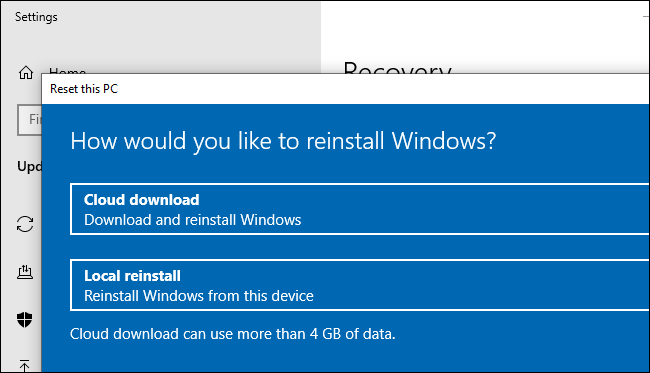
To use this feature on Windows 10’s 20H1 update—currently in development—you’ll just have to head to Settings > Update & Security > Recovery and click “Get Started” under Reset This PC. After you’ve chosen to either keep your files or remove everything from your PC, you can choose “Cloud Download” to download the installation files from Microsoft’s servers or “Local Reinstall” to use the local files on your system.
Lower explains exactly what happens during the reset process, too. In summary, Windows will download the files and then reboot into Windows RE, the Windows Recovery Environment. The installation process will gather the drivers from your current Windows system, ensuring your hardware will continue working. It will also “Apply OEM customizations including preinstalled Windows apps,” so don’t count on it removing all the bloatware your manufacturer installed on your PC. You may still need the Fresh Start feature for that. Check out the blog post for more details.
What Is The Most Abundant Element In The Universe? |
|
Think you know the answer? |
|
The Oldest Planetarium In The World Is Located Where? |
|
Think you know the answer? |
|
Who Is The Longest Recurring Actor In Any Video Game Franchise? |
|
Think you know the answer? |
|
What Did William Shatner Require To Perform The Vulcan Salute? |
|
Think you know the answer? |
|
What Did William Shatner Require To Perform The Vulcan Salute? |
|
Think you know the answer? |
|
Who Gave The Shortest Award Winning Oscar Performance? |
|
Think you know the answer? |
|
Which Country Has The Longest National Anthem? |
|
Think you know the answer? |
|
Famed Psychologist B.F. Skinner Once Taught Pigeons To? |
|
Think you know the answer? |
|
Sensor Tower reports that many mobile game publishers are hitting the $1M earnings milestone in 2021 -- though not as many as in 2016. Rea...


